

Trekking Seasons in Nepal — When Should You Come?
Every Season Has Something Beautiful to Offer
One of the questions we are asked most often is: when is the best time to come? And our honest answer is always: it depends on what you are looking for.
Nepal is a year-round destination. Each season brings its own character, its own beauty, and its own rewards. Our favourites are autumn and spring — but we have had guests who fell completely in love with the monsoon season, and others who found winter to be the most peaceful and memorable time of all.
Here is our honest guide to all four seasons. We hope it helps you find the right moment for your adventure — and please do not hesitate to reach out if you would like our personal recommendation for your specific plans.
Spring Season
(March to May)
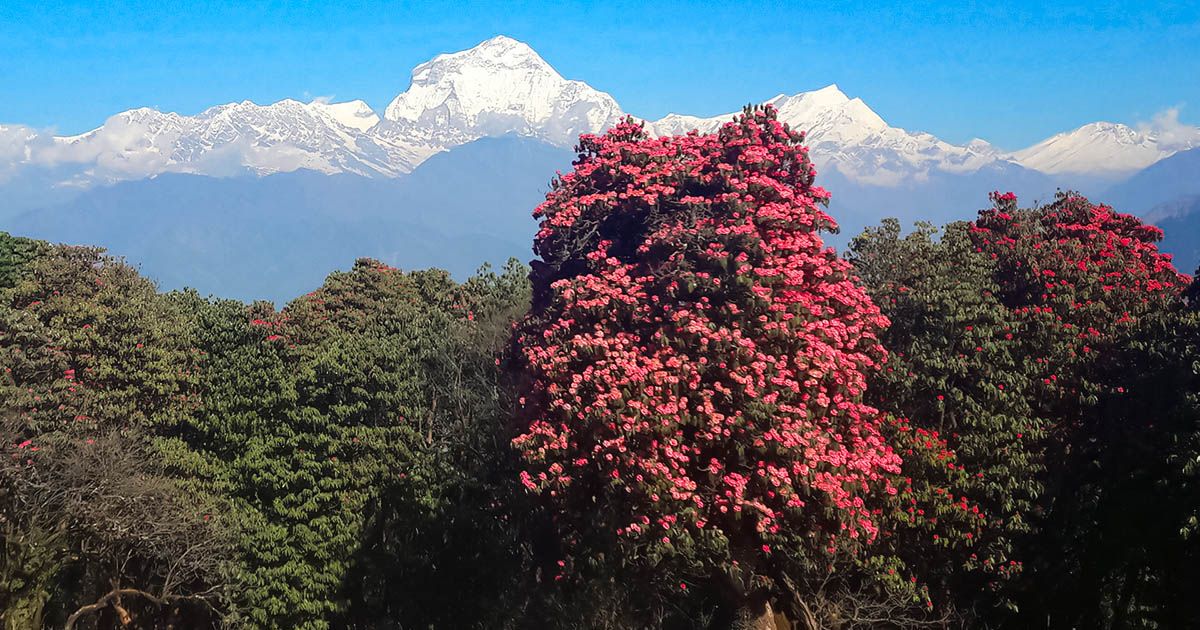
Spring is one of our very favourite times to be in the mountains. After the dry winter months, Nepal comes alive — and nowhere is that more visible than on the lower trails of the Annapurna region, where the rhododendron forests burst into colour in shades of red, pink, and white.
Temperatures are warm and comfortable even at higher elevations, and the mountain views are wonderfully clear. The days are long, the light is beautiful, and the trails feel fresh and full of energy.
Spring is particularly wonderful on the Poon Hill Trek, Mardi Himal Trek, and Annapurna Base Camp Trek — the rhododendron blossom on these routes is something we never get tired of sharing with our guests.
Summer Season
(June to August)
Summer in Nepal is the monsoon season — and we will be honest with you: it rains. The trails can be muddy, the views sometimes cloudy, and the humidity is real.
But there is another side to this season that we genuinely love. The mountains are wonderfully quiet. The rice fields are a vivid, lush green. The waterfalls are at their most powerful. And the sense of having the trails almost entirely to yourself is something very special.
If your schedule only allows for summer travel, please do not be discouraged. Some of our most memorable treks have happened in the monsoon season.
The Annapurna Circuit
and
Lower Mustang are particularly good options during this time, as they lie in the rain shadow of the Himalayas and receive significantly less rainfall.
Autumn Season (September to November)
If we had to choose one season above all others, most of us would choose autumn. The monsoon rains have cleared the air, the skies are an extraordinary deep blue, and the mountain views are at their most spectacular.
The temperatures are comfortable at all elevations during the day, and the trails are in perfect condition. This is peak trekking season in Nepal — and for very good reason.
One thing worth knowing: autumn is also the busiest season, and popular teahouses on major routes can fill up quickly. We would gently recommend booking accommodation in advance, or choosing a quieter route like the Mardi Himal Trek if you prefer a more peaceful experience.
Winter Season
(December to February)
Winter is a season that many guests overlook — and we think that is a shame. The trails are quiet, the air is clear, and on a crisp winter morning the mountains look absolutely magnificent.
Snowfall begins above 2,500 metres, and some higher passes may be closed or require crampons. But the lower and mid-altitude routes remain very accessible and offer a serene, almost meditative trekking experience that is quite different from the busier seasons.
The Poon Hill Trek is one of our favourite winter options — reliable, beautiful, and wonderfully peaceful at this time of year. Winter is also a perfect season to combine a trek with a visit to Chitwan National Park, where the weather in the southern lowlands is mild and very pleasant.
For any winter trek above 3,000 metres, we strongly recommend going with an experienced guide. We are always happy to advise you on the best options for your dates.
Still Not Sure When to Come?
Please do not hesitate to reach out. We are always happy to give you our honest, personal recommendation based on your specific plans, fitness level, and the experience you are looking for. We look forward to hearing from you.