Mardi Himal Trek — Our Favourite Trek From Pokhara
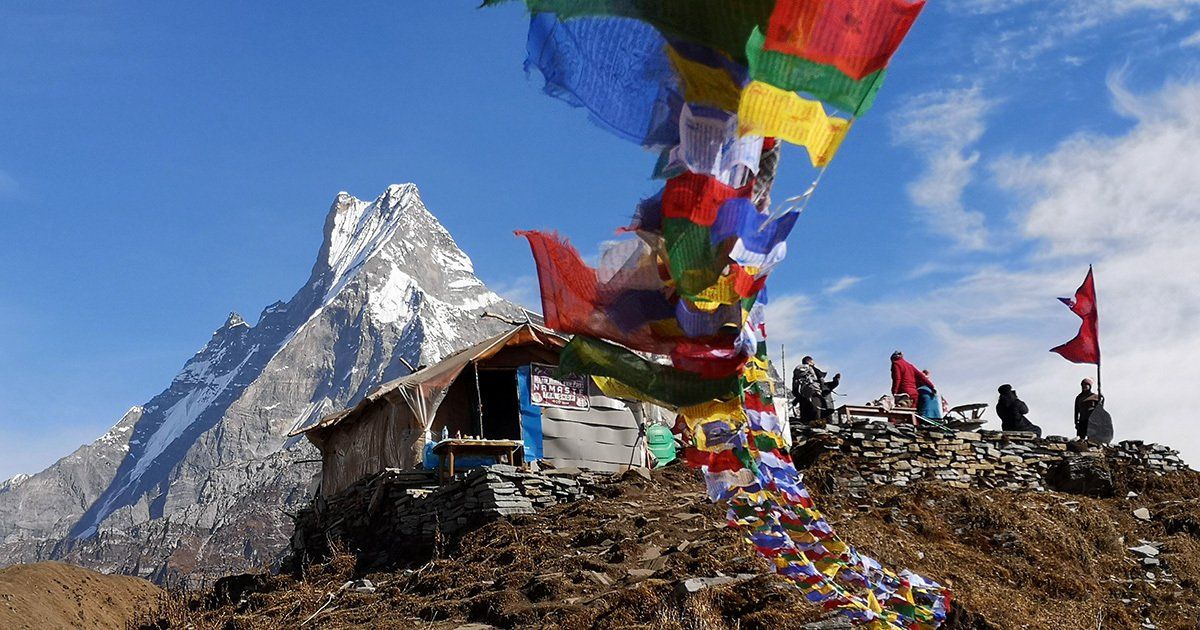
Colorful prayer flags flutter near a rustic shelter on the Mardi Himal trek, with Machhapuchare (6,993 m) towering behind.

The Mardi Himal Trek is a 6-day private trek from Pokhara, guided by our local team. You walk through rhododendron forest and along a high grassy ridge to Mardi Himal Base Camp at 4,500 m / 14,764 ft, right below Machhapuchhre. It is quieter than Annapurna Base Camp or Poon Hill. As a full package, it costs $390 to $450 per person, depending on how many of you are travelling together.

Mardi Himal Trek at a Glance

DURATION

6 days, possible from 5 to 8 days

START AND END

At your hotel in Pokhara Lakeside

HIGHEST POINT

4,500 m / 14,764 ft

DIFFICULTY

Moderate, with one long and demanding day

WALKING PER DAY

4 to 9 hours

ACCOMMODATION

Simple traditional teahouses along the route

MEALS

Breakfast, lunch and dinner, your own choice from the teahouse menu

BEST TIME

February to May and October to December

GUIDE

A licensed local guide from Pokhara, private for you

Highlights:

  • Close views of Machhapuchhre, Mardi Himal, Annapurna South and Hiunchuli, and on clear days Dhaulagiri and Manaslu
  • Quieter, uncrowded trails than most other treks in the Annapurna region
  • Forests of rhododendron and oak, where you may see langur monkeys
  • Village life and teahouse hospitality along the way
  • The whole Annapurna range from Mardi Himal Base Camp (4,500 m / 14,764 ft)


Why the Mardi Himal Trek Is Our Favourite
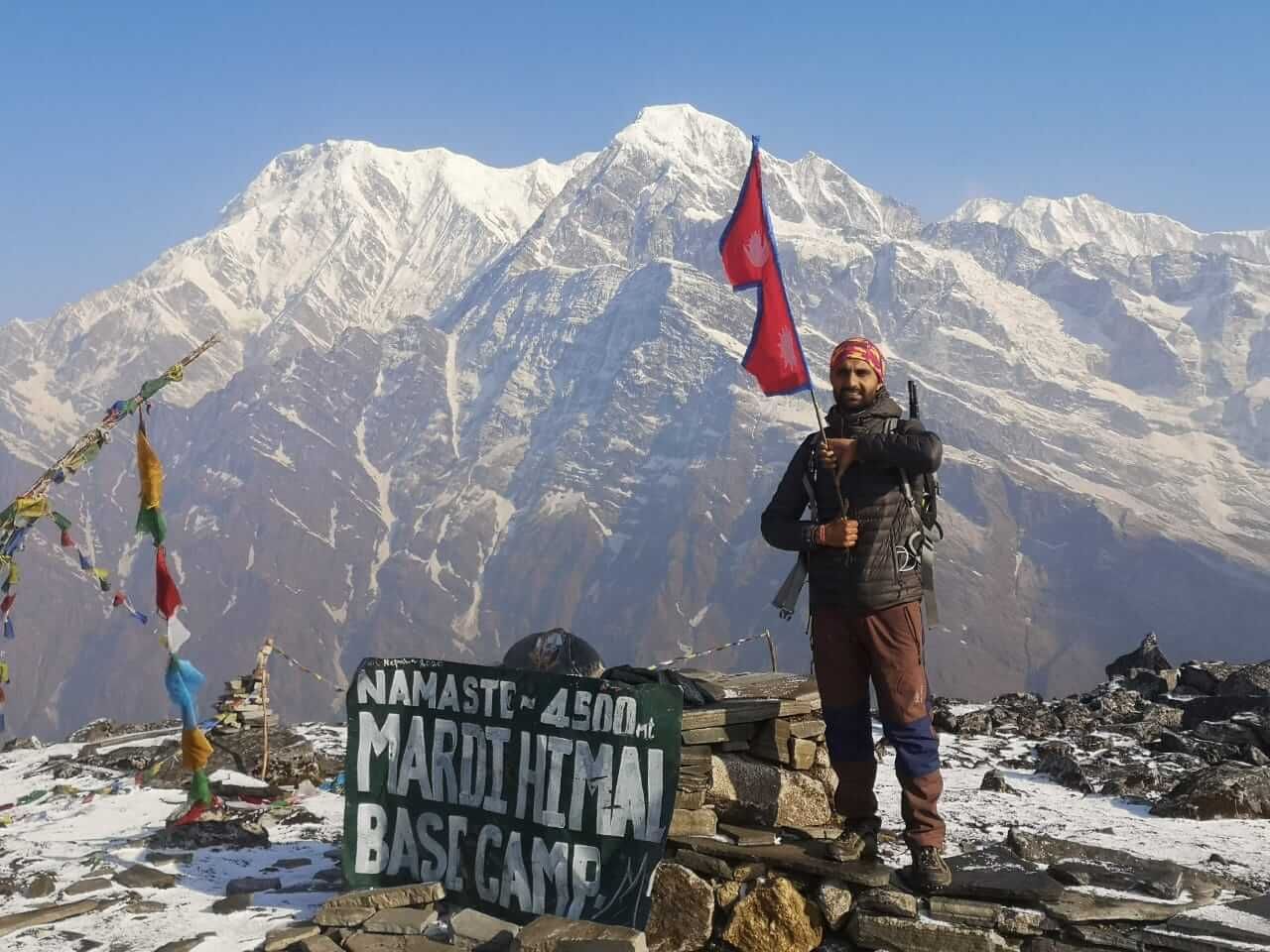
Ask Roman, Yam or Prem which trek they love most, and all three will say Mardi Himal. They have walked this ridge many times. They know where the light is best in the morning, which teahouse makes the warmest dal bhat, and where Machhapuchhre suddenly appears right in front of you.


What we love most is the quiet. Many trekkers head for Annapurna Base Camp or Poon Hill, so on Mardi Himal you share the trail with only a few others. Because we are a local company from Pokhara, we are on this trail all year. Your guide is yours alone, and the pace is yours too.


Meet Our Trekking Crew

Is the Mardi Himal Trek Right for You?

You do not need trekking experience, but you should be able to walk four to five hours a day on steep paths. Day 4 is the hardest: about nine hours, with an early climb to base camp along a narrow, windy ridge and a long way down after.


At 4,500 m / 14,764 ft, altitude matters. Being fit does not protect you from altitude sickness. Fit guests often walk too fast. A slow, steady pace gives your body time to adjust and reduces the risk, so please always follow the pace of your guide. If you are unsure,
please do not hesitate to reach out, we are happy to help you choose.


Mardi Himal Trek Itinerary - 6 Days

Day 1: Pokhara (820 m / 2,690 ft) to Phedi (1,130 m / 3,707 ft) to Deurali (2,173 m / 7,129 ft) - 30 minutes by car, 5 hours walking

Day 2: Deurali to Forest Camp (2,564 m / 8,412 ft) - 5 hours walking

Day 3: Forest Camp to High Camp (3,580 m / 11,745 ft) - 4 hours walking

Day 4: High Camp to Mardi Himal Base Camp (4,500 m / 14,764 ft) and down to Low Camp (3,050 m / 10,007 ft) - 9 hours walking

Day 5: Low Camp to Kalimati (1,790 m / 5,873 ft) - 4 hours walking

Day 6: Kalimati to Lumre (1,190 m / 3,904 ft), then by jeep to your hotel in Pokhara (820 m / 2,690 ft) - 2 hours walking, 2 hours by jeep

  • Mardi Himal Trek Description

    From Pokhara, the trail takes you through dense rhododendron forests, terraced hillside villages, and quiet ridgelines that many trekkers never see.


    The trek is unhurried. The paths are peaceful, the teahouse owners know us by name, and somewhere between the forest and High Camp, something shifts. The mountains get closer, and the noise of everyday life fades away.


    At Mardi Himal Base Camp (4,500 m / 14,764 ft), the views of Machhapuchhre, Annapurna South and the surrounding peaks are among the finest we know. On a clear day, it is a view we never get tired of.


    The trek is moderate, and some preparation helps because of the altitude. We always adapt the pace to you, so please let us know what you need when you reach out.

  • Trekking Seasons for the Mardi Himal Trek

    You can trek Mardi Himal all year, but the best months are February to May and October to December.


    Spring (February to May)

    This is one of our favourite times to be on the trail. From March, the rhododendron forests bloom and the mountain views are often clear. Temperatures are comfortable, around 20°C (68°F) during the day and 5°C (41°F) at night. In February it is colder, and the upper ridge can still have snow and ice.


    Autumn and early winter (October to December)

    October and November usually have the clearest skies of the year, with fresh air and wide views of the mountains. Temperatures are similar to spring. In December it gets colder, and there can be snow and ice on the upper ridge, but the views are often very clear.


    Monsoon (June to September)

    The monsoon brings green landscapes and a quieter trail, but also heavy rain, muddy paths and clouds over the mountains. It is possible to trek in these months, but we would gently advise choosing a different time if you have the flexibility.


    January

    January is cold, the higher sections of the trail can be icy, and snow or clouds can hide the views. The lower parts of the trail stay beautiful and peaceful. Please do reach out, and we will advise you on the best options for your dates.


    Whatever time you choose, please come prepared with warm layers. And please feel free to check the weather forecast for Mardi Himal before you pack.

  • What To Pack for the Mardi Himal Trek

    We have put together a detailed packing guide on our Trekking Equipment page. Please do have a look before you prepare your bag.


    If you are not sure whether to buy or rent your gear, our article Buy or Rent Trekking Gear in Pokhara explains what you can rent in Pokhara and what it costs. The day before the trek, we go with you to a rental shop near our office and help you choose.


    We would also recommend checking the weather forecast for Mardi Himal closer to your departure date, so you know exactly what to expect.

Price and What Is Included

The Mardi Himal Trek is a full package. The price per person depends on how many of you are travelling together: $450 for one person, $420 for two to four people, $390 for five to eight people. You will always know your exact price before you book.

Included


  • Pre-trekking meeting with your guide the day before the trek starts
  • Pick-up and drop-off at your hotel in Pokhara Lakeside
  • Private transport to the trek’s starting point and back
  • Professional, English-speaking guide with full insurance
  • Meals and accommodation for your guide
  • Trekking permits and TIMS cards
  • All meals during the trek (B/L/D), your own choice from the teahouse menu
  • Morning tea or coffee (other drinks not included)
  • Accommodation in simple traditional teahouses/lodges along the route


Not Included


  • Personal expenses such as snacks and drinks on the trek
  • Service of a helper to carry your bags, available at $22 per day per helper (carries up to 15 kg)
  • Tips for guide and helper (discretionary)
  • Travel and rescue insurance
  • Trekking gear rental
  • Accommodation in Pokhara before and after the trek


Mardi Himal Trek FAQ

  • How difficult is the Mardi Himal Trek?

    The Mardi Himal Trek is moderate. Most days have four to five hours of walking, but Day 4 takes about nine hours and climbs to 4,500 m / 14,764 ft. Good fitness helps, but trekking experience is not needed.

  • Is altitude sickness a risk on the Mardi Himal Trek?

    Yes, it can be. You sleep at High Camp (3,580 m / 11,745 ft) and reach Mardi Himal Base Camp at 4,500 m / 14,764 ft, where many people feel the altitude. Being fit does not protect you from altitude sickness. Fit guests often walk too fast and climb too quickly. A slow, steady pace gives your body time to adjust and reduces the risk, so please always follow the pace of your guide, even if you feel strong. Drink enough water, and tell your guide straight away if you get a headache, feel sick or dizzy. Our guides know these signs well and decide with you what is safest. If you have had altitude sickness before, please tell us when you book.

  • Is the Mardi Himal Trek less crowded than Annapurna Base Camp or Poon Hill?

    Yes. Mardi Himal has fewer trekkers than Annapurna Base Camp and Poon Hill, and the villages and teahouses along the way are smaller. On many days you walk through the forest and along the ridge without meeting many other people. The trek has become better known in recent years, so in October and November there are more trekkers on the trail, especially at High Camp. If you are looking for the quietest time, we recommend February, early March or December, when the weather is still good and the trail is much calmer. Whenever you come, we book your teahouse rooms as soon as you send us your details, so you always have a place to stay.

  • Can the Mardi Himal Trek be shorter or longer?

    Yes. The standard trek takes six days. We can shorten it to five days, extend it to seven or eight days for a slower pace, or combine it with the Poon Hill Trek or the Annapurna Base Camp Trek. Please ask us for a price.

  • Do I need a helper (porter) for the Mardi Himal Trek?

    No, a helper is optional. A helper costs $22 per day per helper and carries up to 15 kg, so two guests can often share one. The helper's meals and accommodation are included in this price. A helper makes your trek lighter, and it also means fair, insured work for someone from our local community.

  • Do I have to pay in advance?

    No. There is no payment in advance, you pay once you are here with us. We prefer cash in NPR, USD, GBP or EUR. If you pay in NPR, GBP or EUR, we convert the USD price using the Google exchange rate on the day of payment. You can cancel free of charge up to 48 hours before the trek starts.

  • How do I book the Mardi Himal Trek?

    You can book online on this page, or simply send us an email. Either way, we usually get back to you within 24 hours. You do not need to know your hotel in Pokhara yet. Closer to the trek, we agree on a time for the pre-trek meeting with your guide the day before you start, and you tell us your hotel so we can pick you up there. For the trekking permits, we need a photo of the main page of each traveller’s passport by email, at the latest one week before the trek starts. There is no payment in advance, you pay once you are here with us. We prefer cash in NPR, USD, GBP or EUR. If you pay in NPR, GBP or EUR, we convert the USD price using the Google exchange rate on the day of payment.

  • How much money do I need during the Mardi Himal Trek?

    For drinks, snacks and personal expenses, we suggest around NPR 3,000 per person per day (about $20). It depends a lot on what you like to drink and snack between meals. Soft drinks like Coca-Cola or Fanta, and alcohol, are expensive in the mountains, because everything has to be carried up. Tea, drinking water and homemade lemonade are much cheaper. There are no ATMs along the trail, so please bring enough cash from Pokhara. Tips for your guide and helper are not part of this amount.

Ready to Join Us on the Trail?

Book the Mardi Himal Trek online below, or simply send us an email or a WhatsApp message. No payment now, you pay once you are here with us, and you can cancel free of charge up to 48 hours before the trek starts.

Prefer to Talk First?

Send us an email, or click the green WhatsApp button in the corner of your screen. A simple message is all we need.

Write to Us

What our guests say on TripAdvisor:


Mardi Himal Trek Map — Where We Walk Together

This map shows the full Mardi Himal route, from Pokhara up to Mardi Himal Base Camp at 4,500 m / 14,764 ft, including the villages and teahouses where we stay along the way.
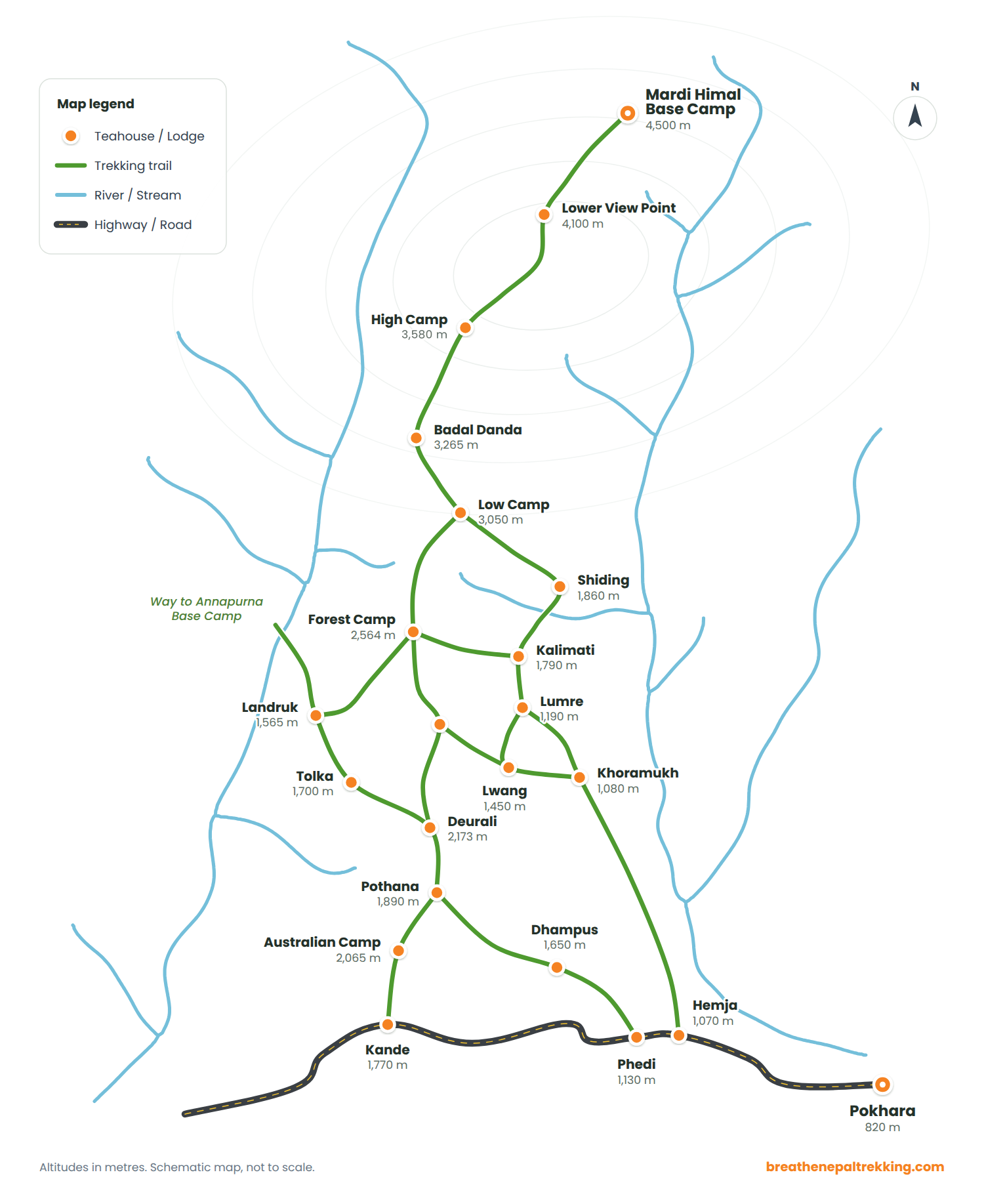
Map of the Mardi Himal Trek  in Nepal, highlighting key trails, landmarks, and elevations for trekkers.
Download the map (PNG)

Save it on your phone, so you have it with you on the trail, even without internet. On a computer, the map opens in a new tab, just right-click it and choose “Save image as”.